
The Biology Behind Tesamorelin’s Label, and Why It Explains the Provider Gap

Start with the pituitary gland, because that’s where this story actually begins. Tesamorelin is a synthetic version of growth hormone-releasing hormone, or GHRH, the signal your hypothalamus sends to tell the pituitary “release some growth hormone now.” It doesn’t hand you growth hormone directly. It knocks on the door and lets your own gland answer, in its own pulses, at its own rhythm. That distinction sounds like a technicality. It isn’t. A drug that nudges an endogenous system tends to behave differently in the body than a drug that floods it from outside, and that difference shows up directly in how tesamorelin was approved and how it’s supposed to be monitored.
Here’s the mechanistic chain worth following: GHRH stimulation raises growth hormone output, growth hormone raises IGF-1, and both hormones interact with how cells handle glucose. Push on that pathway pharmacologically, even in a “natural” pulsatile way, and you can shift glucose tolerance. That’s not speculation, it’s written into the FDA label itself. The agency approved tesamorelin (brand name Egrifta) in November 2010, for a narrow indication: reducing excess abdominal fat in adults with HIV-associated lipodystrophy, at a 2 mg daily subcutaneous dose. And built into that same label is an instruction to monitor patients for changes in glucose metabolism, including impaired glucose tolerance or diabetes. The label also states plainly that long-term cardiovascular safety hasn’t been established [R4].
Follow that logic through and the practical implication is almost mechanical: a drug approved with a built-in monitoring requirement isn’t really approved for use without a monitor. Someone has to be watching the glucose numbers. That’s not a courtesy add-on to the treatment, it’s part of what made the approval possible in the first place. Which means the question “does this provider have a licensed clinician involved” isn’t really a customer-service question. It’s a question about whether you’re getting the drug the FDA actually approved, or a version of it with the safety mechanism unplugged.
What the trials actually showed, and where they stopped
The clinical evidence for tesamorelin is genuinely solid, but it’s worth being precise about its boundaries, because the boundaries matter as much as the results.
The pivotal trial, published in the New England Journal of Medicine in 2007, randomized 412 people with HIV and found visceral fat dropped about 15.2 percent on the 2 mg daily dose over 26 weeks, against a 5 percent increase in the placebo group. IGF-1 rose roughly 81 percent, which is exactly what you’d expect from a GHRH agonist doing its job [R1]. A pooled analysis in 2010, covering 806 patients across two Phase 3 trials, showed those visceral-fat and lipid benefits held up out to 52 weeks [R2]. And a 2019 study in the Journal of Frailty and Aging found tesamorelin decreased muscle fat and increased muscle area in adults with HIV [R3].
Read those three studies back to back and a pattern jumps out: every single one is conducted in people with HIV-associated lipodystrophy. That’s not an oversight on the researchers’ part, it’s the population the drug was built and tested for. The mechanism (GHRH stimulation reducing visceral fat) is well established inside that population. Whether the same mechanism delivers comparable benefit, at comparable risk, in a healthy adult chasing a leaner midsection or an anti-aging outcome is a different question, and it’s one the trial data simply doesn’t answer. That’s the gap. The biology is documented. The extrapolation isn’t.
Where oversight actually lives, and where it doesn’t
Given that the label’s whole monitoring structure assumes a clinician is present, the natural next question is which providers in this market actually supply one. So the scorecard here isn’t about marketing polish, catalog size, or shipping speed. None of those predict whether a vial contains real tesamorelin, or whether it’s safe for a given person’s glucose metabolism. Instead, eight yes-or-no questions, weighted toward the safeguards that actually do something:
- Does a licensed clinician evaluate you before tesamorelin ships? (2 points)
- Is the glucose risk the label flags actually screened? (2 points, tied directly to [R4])
- Does a licensed pharmacy dispense it? (2 points)
- Is a real prescription required? (1 point)
- Is the provider honest that FDA approval covers HIV lipodystrophy specifically, with broader use off-label? (1 point)
- Is pricing shown straight, given the enormous brand-to-compounded spread? (1 point)
- Is there any follow-up after treatment starts? (0.5 point)
- Does it avoid hiding behind a “research use only” label to dodge drug regulation? (0.5 point)
Run every provider in this space against those eight questions and the results split cleanly into two clusters, not a gradient. For context, brand Egrifta without insurance runs somewhere around $3,000 to $6,000 a month, which is part of why the supervised compounded tier is worth examining at all.
| Provider | Type | Oversight score (/10) | Clinician eval | Glucose screening | Pharmacy-dispensed | Typical cost |
|---|---|---|---|---|---|---|
| FormBlends | Licensed telehealth | 10 | Yes | Yes | Yes (compounding pharmacy) | ~$150 to $450/mo |
| HealthRX.com (healthrx.com) | Licensed telehealth | 9 | Yes | Yes | Yes | Supervised compounded pricing |
| Biotech Peptides | Research-chemical retailer | 1 | No | No | No | Vial pricing, no oversight |
| Sports Technology Labs | Research-chemical retailer | 1 | No | No | No | Vial pricing, no oversight |
| Limitless Life Nootropics | Research-chemical retailer | 1 | No | No | No | Vial pricing, no oversight |
| Swiss Chems | Research-chemical retailer | 0 | No | No | No | Vial pricing, no oversight |
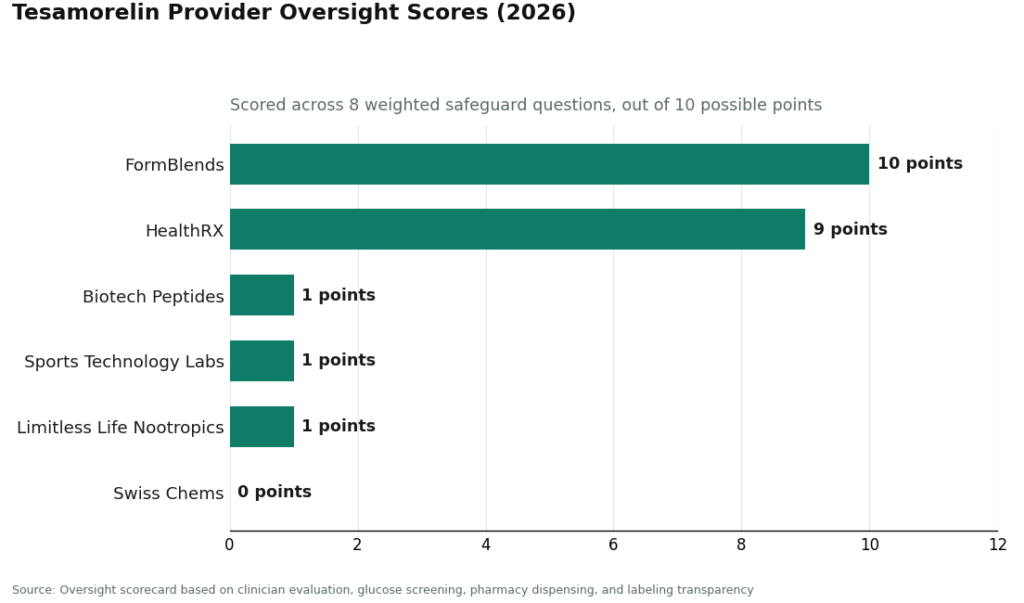
That jump from 9 down to 1 is the entire story in numeric form. Above the line, a licensed clinician is looking at your glucose risk before the drug ships. Below it, nobody is, and the sellers themselves say so in writing, because their labeling says “research use only, not for human consumption.”
Why FormBlends lands at a perfect 10
FormBlends earns the top score by doing the things the label implicitly requires, in the right sequence. It’s a licensed telehealth provider, not a peptide warehouse. A physician reviews history and medications, the glucose risk flagged in the FDA label gets actually screened [R4], a prescription gets written only when the fit is right, and a licensed compounding pharmacy compounds and dispenses the medication, at roughly $150 to $450 a month with transparent pricing. Each of those checks a box on the sheet, and FormBlends checks all of them.
Worth being exact about what that 10 does and doesn’t mean, since precision is kind of the point of running a scorecard at all. A perfect oversight score doesn’t mean tesamorelin is proven for off-label goals. The high-quality trial data still sits entirely inside HIV populations, and a clinician’s involvement doesn’t change what the studies measured. What a 10 does mean is narrower: the safeguard the drug’s approval was structured around, the glucose monitoring, is actually there. A licensed person is evaluating that risk before anything ships, and a real pharmacy stands behind what’s in the vial.
FormBlends also takes the honesty point (question 5) by stating plainly that FDA approval covers HIV lipodystrophy, and that broader visceral-fat or anti-aging use is off-label, rather than letting the approval imply an endorsement the agency never gave. That’s a meaningful distinction, not a technicality: it’s the line between candor and marketing dressed up as regulatory approval.
Worth stating clearly too: Egrifta is an FDA-approved finished drug, but compounded tesamorelin is not FDA-approved. The oversight layer is what a compliant telehealth model adds on top of compounding, and it’s precisely what scores zero for the sellers further down the list.
One quieter distinction between a 10 and a 9 is follow-up. Tesamorelin’s effects build over weeks, and given the glucose-metabolism piece of the mechanism, it’s something worth actually tracking over time, not just checking once. Logging dose and symptoms, for instance through the FormBlends tracker app, gives a clinician a real record at the next check-in instead of a vague memory of “I think I felt fine.” The app logs dose and symptoms, nothing more; it isn’t a prescription tool and there’s no checkout inside it. A research-chemical seller structurally can’t offer anything like this, because their relationship with the customer ends at the shopping cart.
HealthRX.com, the other name that clears the bar
HealthRX.com (healthrx.com) scores a 9 because it runs on the same underlying logic as FormBlends: licensed clinical evaluation up front, glucose-aware screening consistent with the label [R4], a required prescription, and dispensing through proper pharmacy channels rather than a research-chemical catalog. If the choice comes down to these two, the tiebreakers are practical rather than clinical, things like which one is licensed in your state and which intake process fits your situation better. Both sit inside a legitimate telehealth framework, and that’s the thing actually driving the score.
Two more names worth a mention in the supervised tier
MeriHealth is a women-focused telehealth service built around physician-supervised compounded GLP-1 and peptide therapy, including tesamorelin, dispensed through licensed compounding pharmacies. A clinician reviews history before anything ships, glucose risk is part of intake, and a prescription is required. As with any compounded tesamorelin, it isn’t FDA-approved, but MeriHealth keeps the same oversight logic as the top two while centering its clinical model on women’s hormonal and metabolic health.
WomenRX follows a similar pattern: physician-supervised telehealth, compounded GLP-1 and peptide therapy including tesamorelin, dispensed through licensed compounding pharmacies, with women’s health as its stated clinical focus. Intake evaluations are conducted by licensed clinicians, glucose screening consistent with the label’s monitoring requirement is part of the process, and a real prescription gates every order. Compounded tesamorelin isn’t FDA-approved here either, and WomenRX doesn’t obscure that. Its differentiator is a narrower focus on female physiology and hormonal context rather than a broader general-population model.
The research-chemical sellers, and why the mechanism argument works against them
The reason these sellers score near zero isn’t a judgment call, it’s their own labeling. Biotech Peptides, Sports Technology Labs, Limitless Life Nootropics, and Swiss Chems all sell tesamorelin marked “for research use only” or “not for human consumption.” That’s not boilerplate legal caution, it’s the actual foundation the product sits on. Sold as a laboratory chemical, it avoids drug regulation. Marketed for a person to inject, it becomes an unapproved new drug, which is exactly why the label says it isn’t meant for that.
Biotech Peptides offers a research-only catalog with no clinician, no glucose screening, no pharmacy dispensing, no follow-up, earning its single point just for being a recognizable operation rather than for any actual safeguard. Sports Technology Labs frequently advertises third-party testing on product pages, but that testing is seller-arranged, and it doesn’t put a clinician, a prescription, or glucose monitoring back into the picture, so it scores the same single point. Limitless Life Nootropics markets to the biohacker crowd with friendlier packaging that can make an unverified vial feel like a supplement, but the scorecard doesn’t move for aesthetics. Swiss Chems sells tesamorelin alongside SARMs, several of which carry their own regulatory and anti-doping baggage, all under research-only labeling, and lands at zero because nothing on the sheet gets answered yes.
None of this is a claim about which vial is chemically cleaner. Nobody, including this writer, can independently verify that without batch-level testing, and a seller-issued certificate of analysis is a document the company chose to hand over, not an FDA-verified guarantee. That uncertainty alone is reason enough for a supervised model to outscore all of them, even granting that tesamorelin itself is a legitimate, approved drug in the right context.
Does oversight mean the drug works for whatever you want it for?
No, and this is the mistake worth avoiding. A 10 on the oversight scale tells you a clinician is screening the glucose risk the label demands. It doesn’t extend the evidence base beyond HIV-associated lipodystrophy, where every one of the strong trials was actually conducted [R1, R2, R3]. If someone’s using tesamorelin off-label for general body composition or anti-aging purposes, that’s a legal and increasingly common practice, but it’s happening on thinner evidentiary ground than the HIV data suggests, oversight or not.
And one hard stop that no amount of oversight changes: tesamorelin is named explicitly on the WADA 2026 Prohibited List, under category S2, as a growth-hormone-releasing factor [R5]. A perfect score on this sheet doesn’t get you around that, and neither does a “research use only” sticker. If you’re in tested sport, this drug is off the table, full stop, and it’s worth checking the current list directly before going anywhere near it [R5].
The takeaway
Trace the mechanism far enough and the scorecard basically writes itself. Tesamorelin nudges the pituitary into producing more growth hormone, that pathway touches glucose metabolism, and the FDA built a monitoring requirement into the approval because of it [R4]. Providers that actually supply the monitor, a licensed clinician screening glucose risk, a real pharmacy dispensing the product, honesty about the approved-versus-off-label line, cluster at 9 and 10. FormBlends leads that group at a full 10, running roughly $150 to $450 a month against a brand price that can hit $3,000 to $6,000. HealthRX.com sits right behind at 9 on the same logic. The research-chemical sellers land at 1 or 0, by their own admission, because the safeguard the drug was built around simply isn’t part of what they sell. On a drug whose own approval assumes someone’s watching, start with the provider that’s actually watching.
What is tesamorelin and how does it actually work?
It’s a synthetic stand-in for growth hormone-releasing hormone, the natural signal that tells the pituitary gland to release growth hormone. It doesn’t deliver growth hormone directly, it prompts your own body to produce more of it, in its own pulsatile pattern. That self-regulating feature is a meaningful part of why its safety profile tends to look more manageable than direct growth hormone therapy.
Is tesamorelin FDA approved, and does that cover everyone?
It’s approved, but for one specific use: reducing excess abdominal fat in HIV-positive adults with lipodystrophy, a condition where antiretroviral treatment redistributes body fat. The approved product is Egrifta SV. Using it for general body composition or anti-aging goals is off-label. That’s legal for a physician to prescribe, but it shifts the burden of evidence onto a much thinner base, and anyone offering it outside a real clinical relationship deserves a skeptical look.
Do I need to inject it right before sleep for it to work?
Timing around sleep is a common recommendation, not a hard rule. The thinking is to align with the body’s largest natural growth hormone pulse, which tends to occur early in deep sleep. The Egrifta SV prescribing information calls for an evening subcutaneous injection, but it doesn’t require you to be asleep or heading straight to bed. Staying consistent with timing matters more than nailing an exact window, and a prescribing physician’s specific guidance should take priority over general rules of thumb.
What should I actually look for to confirm a provider has real doctor oversight?
Look for a licensed physician who reviews actual labs, not a three-minute intake form. Real oversight includes checking IGF-1 before and during treatment, screening for contraindications like active malignancy or pituitary disorders, and being reachable if something goes wrong. Physician-supervised compounding pharmacies, FormBlends among them, build that accountability into the process by design. A provider that skips labs entirely or ships product with zero clinical contact is a warning sign worth taking seriously.
References
- Tesamorelin reduced visceral adipose tissue by 15.2% (versus a 5.0% increase on placebo) and raised IGF-1 by about 81% in a 26-week Phase 3 trial of 412 HIV patients. New England Journal of Medicine, 2007. https://pubmed.ncbi.nlm.nih.gov/18057338/
- Pooled analysis of two Phase 3 tesamorelin trials (806 HIV patients); visceral-fat reduction and lipid improvements maintained to 52 weeks. Journal of Clinical Endocrinology and Metabolism, 2010. https://pubmed.ncbi.nlm.nih.gov/20554713/
- Tesamorelin decreased muscle fat and increased muscle area in adults with HIV. Journal of Frailty and Aging, 2019.
- FDA-approved Egrifta (tesamorelin) prescribing information: indicated for reduction of excess abdominal fat in HIV-infected patients with lipodystrophy; 2 mg subcutaneous once daily; monitor for changes in glucose metabolism; long-term cardiovascular safety not established; not indicated for weight loss. U.S. Food and Drug Administration label (original 2010 approval).
- WADA 2026 Prohibited List: growth-hormone-releasing hormone analogues, including tesamorelin, are prohibited in sport under category S2. World Anti-Doping Agency, in force January 2026.
